

From the initial site survey to the moment the system goes live, solar panel installation for schools typically takes between 8 and 16 weeks in total. The physical installation itself, including panels on the roof, wiring routed, and the inverter fitted, usually takes just 3 to 7 days on site.
The weeks either side of that are taken up with design, approvals and equipment lead times, none of which require any on-site presence. This guide walks through every stage so that business managers and governors can plan ahead with confidence.
The Solar Panel Installation Timeline for Schools: An Overview
Every school solar project moves through the same six stages, from an initial survey through to commissioning and handover. The table below summarises the full process. The sections that follow explain each stage in more detail, including what the school needs to provide and where delays are most likely to occur.
Stage | What Happens | Typical Duration |
1. Initial Survey | Roof and structural assessment, energy data review | 1–2 weeks to arrange |
2. System Design | Bespoke PV layout, panel count, cable routes, inverter position | 1–2 weeks |
3. Planning & Approvals | Permitted development check, DNO application, building regs | 2–8 weeks |
4. Equipment Lead Time | Panels, inverters and mounting hardware ordered and delivered | 2–4 weeks |
5. Physical Installation | Scaffolding, panel mounting, wiring, inverter installation | 3–7 days on site |
6. Commissioning | System powered up, output tested, grid connection confirmed | 1–3 days |
Total (typical) | Survey to switch-on | 8–16 weeks |
Each Stage of the School Solar Installation Process
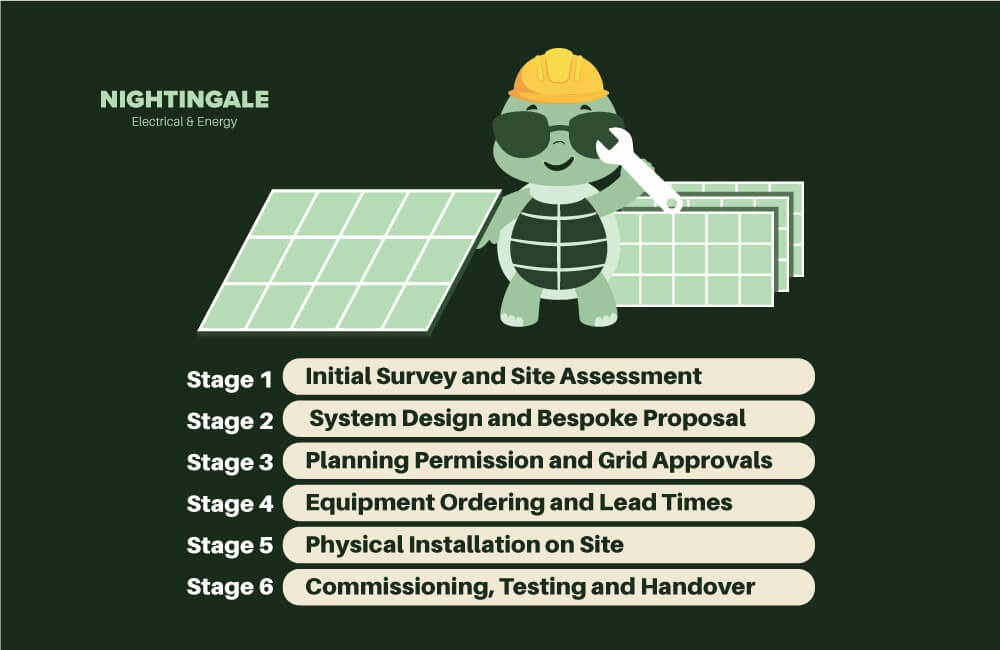
Stage 1: Initial Survey and Site Assessment
The process begins with a site visit from the installation team. At this stage, the installer assesses the roof space and structural condition, checks orientation and shading, and reviews the school's energy consumption data from bills or smart meter records.
This information forms the basis of the system design. Arranging a survey typically takes one to two weeks from initial contact. At Nightingale Energy, site surveys are carried out free of charge with no obligation to proceed.
Stage 2: System Design and Bespoke Proposal
Once the survey data has been collected, the design team creates a bespoke solar PV layout for the school. This covers panel placement, cable routing, inverter location and system output modelling based on the school's actual energy profile.
For larger or more complex sites, structural calculations and detailed risk assessments are also completed at this stage. The school receives a full proposal showing the projected system size, estimated costs and savings, and any funding options that may apply. This stage typically takes one to two weeks.
Stage 3: Planning Permission and Grid Approvals
This is the most variable stage of the process and the one most likely to affect overall timescales. There are two main approvals to consider.
Most school solar installations qualify as permitted development, meaning full planning permission is not required. However, schools in conservation areas or listed buildings may need to apply for prior approval or planning permission, which can add several weeks to the programme. Your installer will confirm this early and handle any applications on your behalf.
Separately, all grid-connected solar systems require approval from the local Distribution Network Operator (DNO). Starting this process early is the single most effective way to keep the overall project on track.
Stage 4: Equipment Ordering and Lead Times
With approvals in place, panels, inverters and mounting hardware are ordered from suppliers. Lead times typically run between two and four weeks, depending on system size and supplier availability. A well-organised installer will begin placing equipment orders in parallel with the approvals process where possible, which can meaningfully reduce the total project duration.
Stage 5: Physical Installation on Site
Physical installation is the shortest and most visible part of the process. For a typical school system, the on-site work takes between three and seven days. Scaffolding is raised first, usually in half a day, then panels are mounted to the roof using a secure aluminium rail system, wiring is routed internally to the inverter and distribution board, and a brief planned power outage is arranged to connect the system to the mains.
This outage is typically isolated to a specific area of the building and agreed in advance with the school.
Stage 6: Commissioning, Testing and Handover
Once the panels are in place, the system is powered up and put through a series of output tests and safety checks before the grid connection is confirmed. The school is then given a walkthrough of the monitoring system, which allows energy generation and savings to be tracked in real time.
This stage takes one to three days. From this point, the system is live and generating electricity. Ongoing maintenance and servicing packages are available to keep the system running at peak performance throughout its 25-plus year lifespan.
Will Solar Panel Installation Disrupt the School Day?
In most cases, no. The stages that take the longest: planning approvals, equipment ordering, and system design, involve no on-site activity whatsoever. The only stage that requires a physical presence at the school is the site visit and installation itself, which at Nightingale Energy is scheduled during school holidays as standard practice.
When Is the Best Time for a School to Start the Solar Process?
Given that the full process takes 8 to 16 weeks, schools targeting a summer holiday installation should ideally begin the process by March or April at the latest. This allows sufficient time for the design and approval stages to be completed before summer, leaving the physical installation ready to be scheduled during the holiday window without any time pressure.
The earlier the process begins, the more flexibility there is if delays arise at the planning or grid approval stage. To understand how many panels your school is likely to need before starting, see our guide to how many solar panels a school needs.
Get started with solar for schools today
Get in touch with Nightingale Energy to discuss solar panel options for your school today. We manage everything from the initial survey through to commissioning, handling all approvals and paperwork on your behalf. To get started, request a free quote from us today.
Get in Touch with Nightingale
Request a call from one of our experts today and get a quote within the week