

You don’t need solar panels to get battery storage. If you’re in Bolton or anywhere across the North West, that’s worth knowing: the region records more power outages than anywhere else in the UK, and a battery that charges from the grid alone can keep your home running when the power goes down.
It also works as a genuine cost-saving tool on its own, without a single solar panel on your roof. Here’s how battery-only storage works, what it costs, and whether it’s worth it for your home.
Can you get battery storage without solar panels?
Yes. While battery storage is most commonly sold alongside solar panels, that’s a sales pairing, not a technical requirement. A battery-only system connects to your home’s electricity supply directly, charging from the grid rather than from solar generation, and discharging into the home whenever you need power.
For homeowners who don’t have solar, don’t want it, or already know panels aren’t right for their roof, that opens up two clear reasons to install a battery anyway: charging cheaply on an off-peak tariff and keeping the lights on during a power cut. Both work without a single solar panel.
Discuss Your Battery Storage Options
How AC-coupled battery storage works
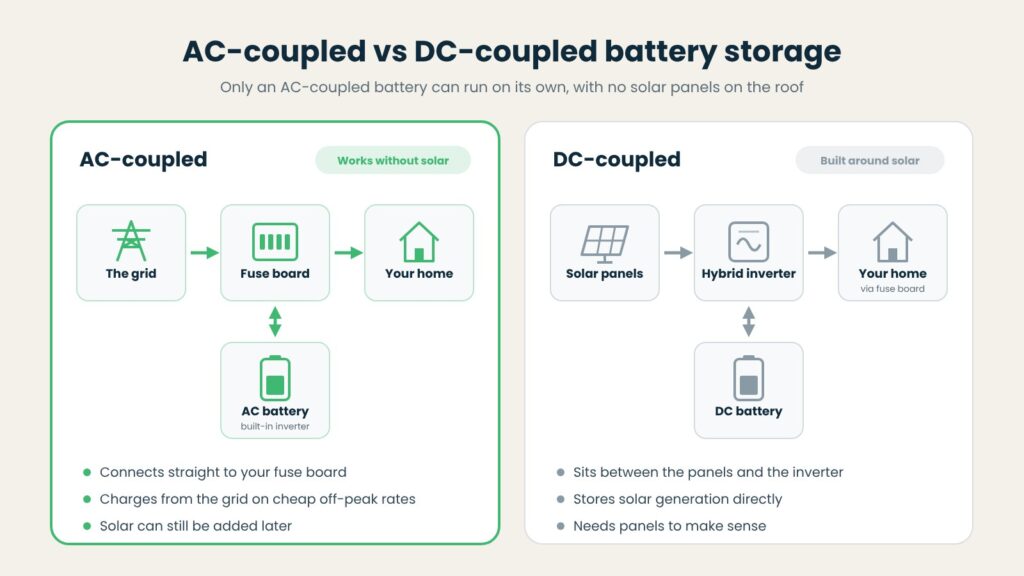
The technical distinction that makes this possible is AC-coupled versus DC-coupled battery storage. A DC-coupled battery sits between the solar panels and the inverter, built to store solar generation directly, which is why it needs solar to make sense in the first place.
An AC-coupled battery connects to your home’s fuse board instead, independent of any solar array. That’s what makes a battery-only install possible without adding or replacing an inverter for panels you don’t have. It costs a little more than a DC-coupled system and loses a small amount of efficiency to the extra conversion step, but that trade-off barely matters when there’s no solar generation to optimise for in the first place.
Battery storage as backup power: why it matters in the North West
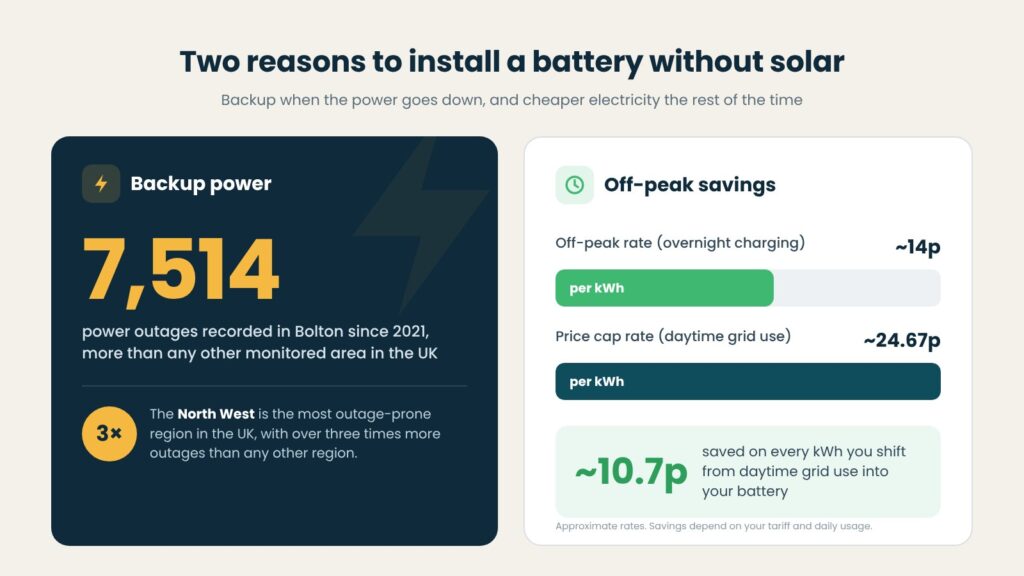
Cost savings aside, backup power is often the stronger reason to install a battery without solar. Bolton has recorded 7,514 power outages since 2021, more than any other monitored area in the UK, and the North West as a whole is the most outage-prone region in the country, over three times more than any other region.
A battery-only system charged from the grid still keeps essential circuits running when supply goes down, without needing daylight or solar generation to top it up first. For homes in Bolton and across the North West, that’s a genuinely practical reason to install one. Storms and outages here are common enough that resilience isn’t a hypothetical.
What battery storage without solar costs to run
The economics work the same way as an off-peak tariff like Economy 7 or Octopus Flux: charge the battery overnight on a cheap rate, then run the home from stored power during the day when electricity costs more. Off-peak rates typically sit around 14p/kWh, against a current price cap rate of roughly 24.67p/kWh, a meaningful gap even with no solar offsetting your daytime use.
That gap is what makes a battery worth running even without free solar power. As with any off-peak setup, savings scale with how much of your daily usage you can shift into the battery, so it’s worth checking your typical consumption against a battery’s usable capacity before you commit. Our Tesla Powerwall 3 review and Duracell solar battery review both cover usable capacity in more detail, useful reading whether or not you’re pairing the battery with solar.
Is battery storage worth it without solar panels?
For most homes, yes, provided you’re getting value from at least one of the two angles above. If overnight power cuts are a real risk where you live, particularly across Bolton and the North West, the backup case alone can justify the investment. If cheap overnight charging on its own covers a meaningful share of your daily usage, the cost case holds up too.
Where a battery makes less sense without solar is a household with light daily usage and no particular exposure to outages, since there’s less to save and less to protect against. It’s still worth reading our guide on whether battery storage is worth it this winter, especially now that battery storage and solar are increasingly discussed together.
Getting battery-only storage installed
Installing a battery-only system follows a similar process to any battery installation, with a few differences worth knowing upfront:
- Confirm AC-coupled compatibility with your installer, since that’s the setup built for battery-only systems. Most modern batteries, including the Tesla Powerwall 3 and Duracell battery, support it.
- Check your fuse board and electrical supply can take the new connection, usually straightforward but worth confirming before you commit to a system size.
- Set a forced charge schedule matching your tariff’s off-peak hours, the same step needed for any Economy 7 or off-peak setup.
- Decide how much backup coverage you want, whole-home or essential circuits only, since that affects the battery size and installation cost.
Solar can always be added later if you change your mind. An AC-coupled system doesn’t lock you out of it, it just isn’t a requirement to get started.
Get help choosing the right battery setup
Every home in Bolton and the North West has different priorities, whether that’s backup power for the next outage, lower overnight running costs, or both.
If you’re not sure whether a battery-only system suits your home, or how it compares to adding solar as well, get in touch with Nightingale Energy and we’ll recommend a setup that actually pays for itself.