

Duracell entered the UK home battery market with one big advantage other brands work years to earn: instant brand recognition. But brand alone doesn't make a battery worth fitting to your house, so we've put this review together based on what we actually see on the ground during Duracell solar battery installation jobs across the North West.
This is an installer's review of the Dura5, Dura16 and Energy Bank. We’ll look at specs, real-world performance, costs, and the question that actually matters: which model suits which kind of home.
What is the Duracell solar battery range?
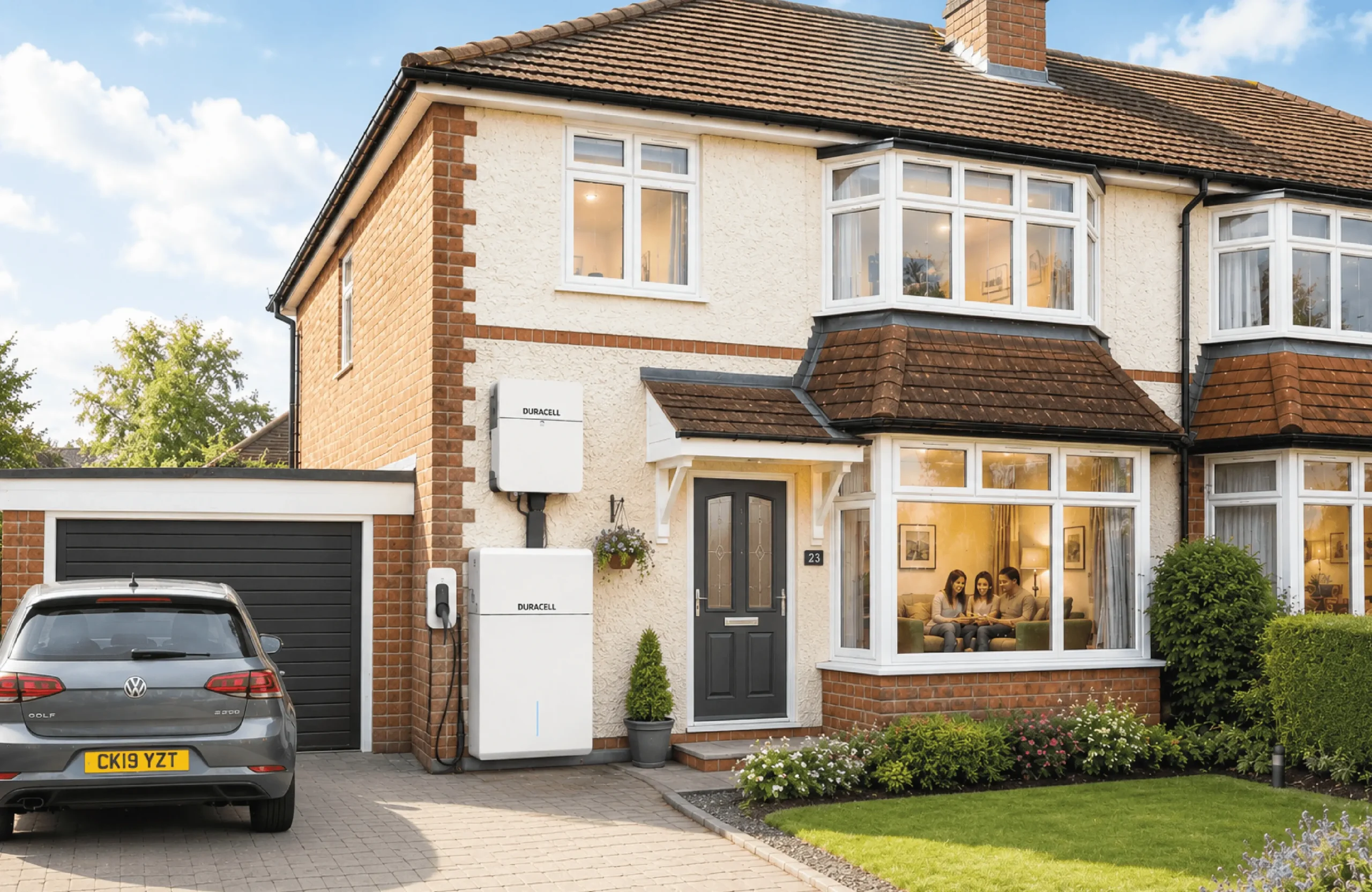
Duracell Energy entered the UK market in partnership with established storage manufacturers, branding a proven modular platform under the Duracell name. The result is a three-tier residential range that covers most domestic use cases without overcomplicating the spec sheet.
If you're new to home batteries entirely, our battery storage overview covers the fundamentals first, including how they pair with solar PV, how off-peak charging works, and what the savings look like over time.
What sets the Duracell range apart isn't any single headline specification, it's the combination of brand reassurance, a strong manufacturer warranty, and modular wiring that means an underpowered system can usually be expanded later rather than ripped out and replaced.
Duracell Dura5 review
The Dura5 is the entry-level option, offering around 5.12 kWh of usable storage in a single wall-mounted unit.
What it does well:
Compact footprint which fits indoors or outdoors, useful where wall space is tight
Quiet operation and sensible aesthetics
A clean retrofit for an existing 3–4 kWp solar array
Lower upfront cost makes it the easiest ‘first battery’ decision
Where it falls short:
5 kWh isn't enough for whole-home backup - it'll cover essentials (fridge, router, lights, a few sockets) but not the whole house
Heavy electricity users (home EV charging, heat pump, electric heating) will outgrow it inside a year or two
Best fit: small-to-mid-sized homes with light-to-moderate evening loads, and anyone wanting to start small and expand later.
Duracell Dura16 review
The Dura16 is the mid-range stackable system, configurable up to around 16 kWh of usable storage across multiple modules.
What it does well:
Whole-home backup capability during an outage, not just essential circuits
Modular architecture means you can start at, say, 10 kWh and add capacity later
Pairs naturally with EV charging on off-peak tariffs
Stronger performance than the Dura5 without jumping to commercial-tier kit
Where it falls short:
Bigger upfront spend - typically £7,000–£10,000 installed depending on configuration
Needs more wall space, which isn't always practical in small terraced utility rooms
Probably overkill for households with modest evening loads
Best fit: larger detached or semi-detached homes, EV-owning families, and households who want backup covering most of the house rather than just the essentials.
Duracell Energy Bank review
The Duracell Energy Bank is the broader modular range that gives us the most flexibility to tailor a system to a specific demand profile for cases where neither the Dura5 nor Dura16 quite hits the brief.
What it does well:
Flexible capacity scaling for unusual or complex demand patterns
Same platform and warranty as the rest of the Duracell range
A clean answer when a household sits awkwardly between Dura5 and Dura16
Where it falls short:
Configuration is bespoke per install which can be more complicated
Pricing depends entirely on the spec, so harder to quote without a survey
Not always the cheapest path for a standard household, so a straight Dura16 is sometimes simpler
Best fit: homes with non-standard energy profiles, mixed-use properties (working from home plus EV plus heat pump), or anywhere stock products don't quite fit.
Dura5 vs Dura16 vs Energy Bank: which one should you buy?
In practice, the choice is usually clearer than it sounds. Four questions normally settle it.
How much electricity do you actually use after dark?
Under 7 kWh evenings → Dura5 is plenty
7–12 kWh evenings → Dura16 starts paying back faster
12 kWh+ (heat pump plus EV) → Dura16 or Energy Bank
Do you want backup during a power cut?
Essential circuits only → Dura5 will cover it
Whole-home backup → Dura16 or Energy Bank
Have you got room for the unit?
Tight utility room or under-stair only → Dura5
Garage or larger plant room → any model
What's the budget?
£5,000–£6,000 → Dura5
£7,000–£10,000 → Dura16
Above £10,000 or bespoke configuration → Energy Bank territory
We work all four through during a free site survey so the spec matches your actual usage, not someone's worst-case guess.
Duracell vs Tesla Powerwall 3
This is the comparison we get asked about most often, and the honest answer is they're built for slightly different households, not better or worse than each other.
The Tesla Powerwall 3 is a single 13.5 kWh unit with an integrated hybrid inverter, designed as a complete whole-home backup system from day one. It's a tidy install, a polished app, and a strong choice if you want the whole-house piece sorted in one box and you're comfortable with Tesla's ecosystem. For a closer look at how it actually performs, our Tesla Powerwall 3 review covers it in detail.
Duracell takes a different route: modular, scalable, and starting at a lower price point. You can buy less now and add more later, and the brand is one most UK households recognise instantly.
So which is right for you? The shorthand is roughly:
Want a single, all-in-one solution with a known maximum capacity? Look at the Powerwall 3.
Want to start smaller, scale gradually, or buy a name you recognise from the high street? Look at Duracell.
Both come with sensible warranties, both work properly with EV charging tariffs, and both will reduce your bills if specced correctly. We install both, and we'll recommend whichever genuinely fits your home best, not whichever pays the higher margin.
Should you buy a Duracell solar battery?
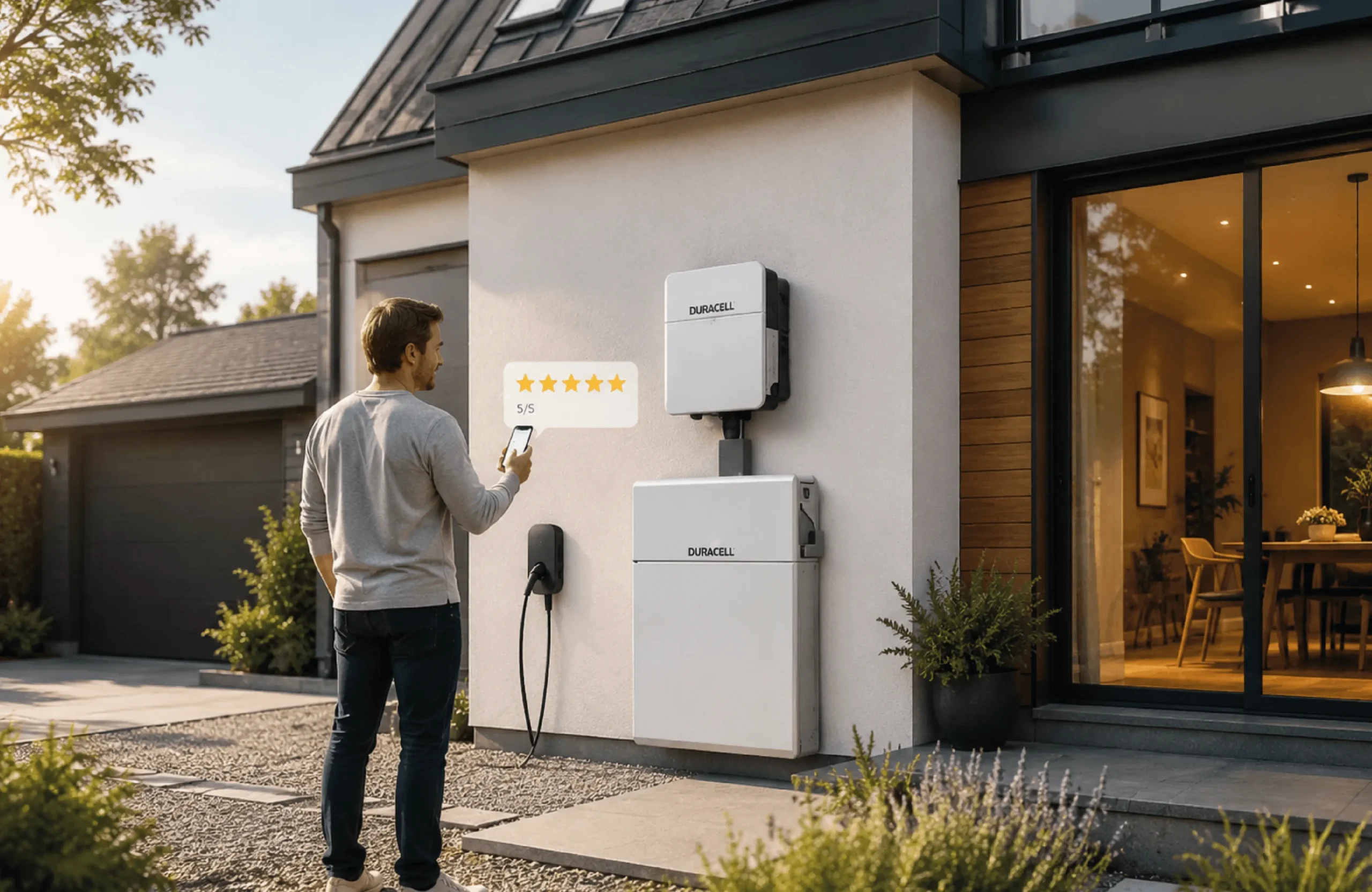
For the majority of UK households, the answer is yes.
The Duracell range earns its place by being practical, modular and backed by a brand people trust. The Dura5 is a sensible first step for smaller homes. The Dura16 is the workhorse for typical detached and semi-detached households. The Energy Bank is there when the standard models don't quite fit.
What you should not do is buy a Duracell battery on brand recognition alone without checking the spec matches your home. Oversizing is wasted money. Undersizing means you're paying for storage that runs out by 9pm. Both are common mistakes when buyers skip the survey.
That's where working with an MCS-approved installer really earns its keep. We'll match the model to your actual usage, register your warranty correctly, and stay close by for ongoing maintenance and servicing and inverter replacement if it's ever needed.
Get a Duracell home battery quote in the North West
We install Duracell solar batteries across the North West: Bolton, Manchester, Chorley, Wigan, Liverpool, and more. If your project sits in any of these areas, the easiest next step is a site survey.
Get in Touch for a Home Survey
Request a call from one of our experts today and get a quote within the week